It's All About Priorities: The Comedy Ad That Proves Your Problem Matters Most


Founder and Head of Growth, White Label Comedy
The fastest way to show how much a problem matters is to make someone care about it more than their own survival.
That is the whole format. Put your customer in a genuine life-or-death moment, stranded on an island, stuck on a roof in a flood, sat in front of a doctor with bad news, and have them spend their one shot at rescue on the problem your product solves. The joke is the absurd ranking of priorities. The selling point hiding underneath it is that this problem is never off their mind.

Why does the misplaced priorities joke work?
Because everyone already knows what the right priority is, so they spot the wrong one instantly.
A desert island has one sensible message to write in the sand, and everybody knows what it is. When the castaway writes something else, the reader's brain catches the mismatch in a fraction of a second, and that mismatch is the laugh. You do not need to explain the setup. Decades of films and cartoons have done it for you.
The clever part is what the joke admits. Nobody would really ignore their own rescue to complain about their ad account. But anyone who has stared at a rising cost per click at 11pm knows the feeling is not that far off. The exaggeration says "this problem takes over your whole head" in a way a plain claim never could, and the reader laughs because they recognise themselves in it.
How is this different from the emergency service angle?
Here the emergency has nothing to do with your product, and that is the point.
In the emergency service format, you take the customer's moment of need and dramatise the problem itself into a 999 call. Here the crisis is a real, unrelated one (a flood, a diagnosis, an arrest) and your customer's problem muscles in and outranks it. One makes the problem feel urgent. The other makes it feel all consuming. The same flood rescue makes this clear:

How do I build one for my business?
Pick a famous high-stakes moment, then swap the obvious priority for your customer's problem.
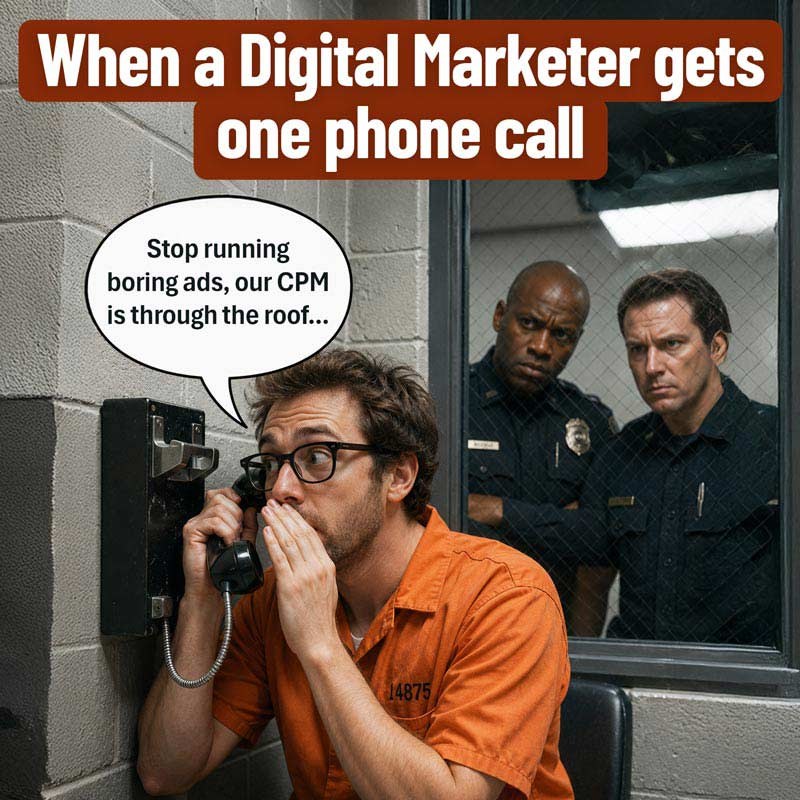
- Choose a scene everyone knows. Desert islands, SOS signs, the one phone call from a police cell, the doctor's office. The more familiar the scene, the less work the reader has to do and the faster the twist lands.
- Find the single action that should save them. The sand message, the rooftop sign, the phone call. That one action is your slot.
- Fill the slot with your customer's problem, in their own words. Not your product name. The complaint they actually make, the thing they mutter at their screen. For a plumber's customer it might be "the boiler is still making that noise". For a marketer it is "stop running boring ads".
- Keep everything else deadpan. Play the scene completely straight. Real stakes, real setting, serious faces. The only absurd thing in the picture should be the priority.
Dialogue versions work just as well, and they let you put the twist in the final line:
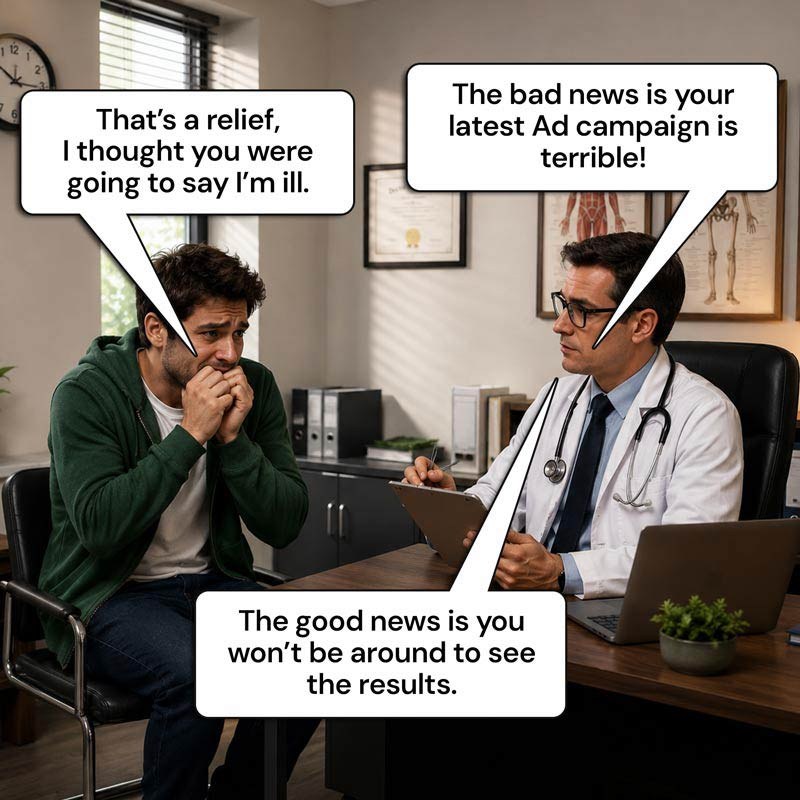
The doctor ad goes one step further. The patient is relieved to hear his ads are terrible rather than that he is ill, and then the doctor reverses it. Two flips in three lines. Once your audience knows the format, you can start playing with it like this.
How do I stop it feeling dark or off-putting?
Keep the danger cartoonish and make sure nobody is actually hurt.
Life-or-death settings carry risk. A real disaster in the news or a too-realistic illness can tip the joke into poor taste fast. Stick to stock scenarios people treat as comedy shorthand (the desert island, the jail phone call) and stay away from anything tied to a current tragedy. If the doctor scene feels too close to home for your audience, the island will do the same job with none of the baggage.
Then check the problem is real. The format only sells if your audience genuinely thinks about this problem all the time. If they don't, the exaggeration has nothing to stand on, and the ad just looks strange.
Meet Brian
Finding the problem your customer cannot stop thinking about, then dropping it into a scene the whole feed recognises, is exactly what Brian does.
Brian is the world's only genuinely funny AI Marketer. He researches your ideal customer, maps out the angles that will resonate, writes your ad copy, punches it up with jokes and builds the creatives too. Every week he gets five brand new Comedy Creative frameworks, including this one, so you always have a fresh format ready.
Try Brian on your next campaign and make your problem the only thing they can think about.
Adam Hunt
Founder and Head of Growth at White Label Comedy. He spends his days convincing serious brands that funny is the most profitable thing they're not doing.
Your marketing isn’t broken. It’s just boring.
It’s time you met the agency behind the internet’s most profitable funny brands.
Work with us