Category: Social Media Marketing

Digital Marketing Skills

5 Digital Marketing Skills to Learn in 2020

We all have strengths and weaknesses. Perhaps you’re great at writing emails that generate leads, but don’t know your Twitter from your TikTok. Maybe you’re a whizz with words but you’ve never opened Photoshop in your life. That’s all well and good, but if you want to be successful in the ever-evolving world of digital marketing, you need to be the full package. This means working on your weaknesses and continually bolstering your strengths. Whether you’re launching a new business, or applying for your next digital marketing job — hell, even if you were King of the Social Media Marketing World 2019 — developing your skill set in these five key areas will help you achieve digital marketing success in 2020. Five Essential Digital Marketing Skills Copywriting From website landing pages to blog posts, email marketing campaigns to Facebook statuses, copy is everywhere you look. The ability to use the written word to engage your audience, generates leads and drive conversions is one of the most important digital marketing skills you can learn. Digital marketing revolves around content. In order to get potential customers to absorb your message and consider your product or service, you need to create content that engages, entertains and inspires. Aim to write content that does all three. If you want to minimise the amount of time you spend writing, blog about subjects that are relatively evergreen. That way you’ll reap the rewards of your efforts for years to come. Keep search engine optimization (SEO) in mind as you write — there’s no point writing awesome articles if no one can find them. There are plenty of marketing automation tools available that will help you identify relevant keywords. Include these in your copy to give your pages a boost in search results, but remember —readability comes first! After all, it’s not the search engines that buy your products. Even if you’re not churning out content for your website (you should be), your copywriting ability can make or break your sales emails. Without a tantalising subject line, your recipients won’t open them. Without engaging body copy, they’ll get distracted halfway through reading, and without a compelling CTA, they’ll never convert. Yes, you can pay a copywriter to write everything for you. But their services don’t come cheap, and you’ll still end up writing some stuff yourself. Copywriting is a a vital skill to add to your social media marketing resume. The quick sales pitch to a new connection on LinkedIn, or the Facebook status about a trending subject — when you’re in a time sensitive situation, your own ability to string a few words together can make the difference between success and failure. Take an online course or read a book, install software to check your grammar, and above all — practise, practise, practise. Data Analysis and Data Management Digital marketing is neither an ‘art’ nor a ‘science’ — it’s a blend of both, and this is the science part. Your digital marketing channels provide you with a barrage of data, but unless you’ve taken the time to develop your understanding of analytics tools, you’ll never be able to make sense of what’s in front of you. This is a huge missed opportunity. Spend time getting to know Google Analytics and the insight tools native to each of your social media platforms. Which channels are successfully driving traffic to your website? How long do readers spend on your blog pages? How many of them convert? If you can objectively identify what works and what doesn’t, you can adjust your marketing strategies accordingly and optimise ROI. Otherwise you’re essentially working in the dark. Data management is a related skill. You’ll collect a lot of consumer data — from website visits, mailing list sign ups, booking and purchases. This can all be analysed and leveraged to inform your digital marketing activity, such as targeted advertising. You need to manage this data in a way that is easy for you and your team to navigate, and compliant with all data protection regulations. It’s not glamorous, but a little time spent implementing efficient and secure data management systems will allow your more creative digital marketing skills to shine. Visual Communication We’ve mentioned the importance of well-written blogs and other copy, but so much of digital marketing comes down to visual communication. Stunning product photos, cohesive design across your websites and email marketing, engaging social media video content and more — the visuals you publish on digital channels don’t contribute to your brand image. They are your brand image. Even if you delegate the bulk of your visual content creation to professional photographers, designers and video producers, most digital marketers (particularly small business owners) end up doing some of it themselves. A phone with a decent camera may be the only equipment you need to populate your Instagram feed with photos and video — particularly if you’re going for a rough around the edges ‘behind-the-scenes’ content style. But if you’re taking photos for your website, e-commerce platforms or for distribution to digital press, it’s worth learning to use a DSLR camera and lighting setup. Likewise, every digital marketer should develop rudimentary design skills. You don’t need to master the entire Abobe Creative Suite, but knowing your way around Photoshop (or even developing your drawing skills) will help you communicate your ideas more effectively — whether that’s to your audience, or to the designer who’s going to turn your rough idea into a finished design. Paid Advertising There are many types of online advertising, and digital marketers should be familiar with as many as possible. Do you know the difference between PPC (pay-per-click) advertising and a boosted post? Knowing the ins and outs of each will help you allocate your advertising budget most effectively. Get to know the major advertising platforms such as Google Ads and Facebook Ads, as well as any that are specifically relevant to your industry, for example Google Hotel Ads. Look into the relative merits of advertising on

Read More »
Digital Marketing Header

Digital Marketing

Digital marketing can seem like a sprawling subject to the uninitiated. The good news is it’s not as complicated as it sounds — in fact, the basics can be broken down into five pillars. This article will introduce these five pillars — giving you the information you need to start developing your digital marketing plan and maximise results from your marketing efforts. But first, let’s revisit the basics. What is Digital Marketing? Just like traditional marketing, digital marketing is the act of trying to sell products or services to someone. The only difference is that this marketing is delivered via digital channels. Many people leap to the assumption that ‘digital’ means ‘online’. This is not the case. Digital means electronic, and digital platforms can be online or offline. Examples of offline digital marketing include: Radio marketing Television advertising Electronic billboards Phone marketing (calls or texts) Touchscreen devices in venues Digital product samples In this particular article, we’re going to focus on online marketing — as this is where most digital marketers will see the greatest return on investment. We’ll take a look at ways you can optimise your offline marketing another time. Which of the following characteristics distinguish online media from traditional marketing? Online marketing happens on the internet. Done! Now that’s cleared up, it’s time to introduce the five pillars of online digital marketing activity. Content Marketing Content marketing is the creation and distribution of content designed to promote brand awareness, generate leads and sales and drive web traffic. Successful content marketing is about producing and providing digital content (usually free of charge) that interests your audience, and then leveraging that interest to market your products or services. Many marketers make the mistake of thinking this simply means ‘write blog posts’. Yes, blogs are one form of content. But ‘content’ refers to an almost unlimited variety of digital media assets including photos, videos, graphic design elements, e-books and white papers, podcasts and more. Due to this broad scope, content marketing tactics can (and should) be applied to every stage of the customer journey— from helping you make a memorable first impression to securing that sale. Wherever it sits in your sales funnel, your content must educate, inspire or entertain. Ideally it will do more than one of those (and comedy is a tried-and-tested way to combine all three)! In short, your content needs to provide value to potential customers. If it doesn’t, they won’t be sufficiently driven to spend time engaging with it — and if they don’t engage with your content, your content can’t move them along on their customer journey. There’s a reason this is the first pillar — compelling content is the most important part of any digital marketing strategy. The following four pillars are essentially content delivery systems. Their relative success or failure will rely on your ability to produce content that your potential customers can’t resist — whether they view it on your website, their social feeds, in their email inbox or as a pop-up ad. Search Engine Optimization (SEO) For most businesses, their website is their online hub. It’s where sales are secured and payment is taken; it’s where potential customers learn about their offering and get in touch to make a booking. It goes without saying that your website should be well designed, aesthetically pleasing, and optimised for mobile devices, but all that effort will go to waste if no one can find it. Search engine optimisation is the process of adjusting your website so it ranks higher in search engine results. There are three main areas to address when it comes to SEO, and an effective strategy incorporates all three: On-page SEO This is about optimising the content that appears on your website. Digital marketers should aim to publish content that provides value and includes keywords that potential customers are likely to search for. Marketing automation tools can help you identify relevant keywords. Publishing content that provides genuine value (leading to website visitors spending more time on the page, engaging with the content) will help boost your website up the SERPs (search engine results pages). Blog posts are a great way to do this — but keywords can also appear in other web copy, such as an About Us section. Technical SEO This refers to factors in your website’s backend (such as coding and image compression) that can impact on your page load speed, which in turn impacts search engine rankings. A technical SEO expert can help identify hidden issues with your website that may be negatively impacting search performance. Off-page SEO This strand of SEO is so called because it happens away from your website. Securing inbound links (or backlinks) from other websites — particularly those that the search engines deem to have a degree of ‘authority’ — will boost your website up the SERPs. You can do this by networking with other digital marketers and writing guest posts for their websites that include a link to your own. Of course, the best way to encourage others to link to your content is to simply create content that everyone wants to link to — because it educates, entertains and inspires. Social Media Marketing Successful digital marketers use social media to build brand awareness, drive traffic and generate sales. It’s a highly diverse and flexible pillar of online digital marketing, and when it comes to boosting brand awareness, it’s far and away your most important digital marketing channel. The specific social networks that a brand chooses to engage with will depend on the preferences of their ideal customer — Facebook is fairly universal, but are your ideal customers more likely to use LinkedIn or Pinterest, Instagram or Twitter, Snapchat or TikTok? Whichever social media platforms you’re on, content is key. Whether it’s images, videos or links to a blog, sharing irresistible content is the only way to get your brand name and message onto new screens every day. When users like, comment or share your post (either because it’s educational,

Read More »
E-Commerce Success Stories

5 Digital Marketing & E-Commerce Success Stories To Draw Inspiration From

Whether you’re just starting out in digital marketing, or you’re a digital marketing professional looking to optimise your existing e-commerce businesses, it’s important to keep developing your skills. One of the best ways to do this is learn from the successes of other entrepreneurs and marketers! We’ve compiled five of the best digital marketing e-commerce success stories we could find. Read on to be inspired and pick up tried-and-tested tactics to incorporate into your marketing strategy. Tips from 5 Inspiring Digital Marketing Case Studies 1. Traveller Collective This brand is a fantastic case study in social media marketing. Traveller Collective produces engraved rings representing every country in the world. Travellers can collect these to display on a clip or necklace , and a percentage of their purchase goes towards a charitable project. Over ten thousand people from more than one hundred countries have bought Traveller Collective products, and this success can be attributed to their use of social media. Firstly, they’ve identified which social media platforms are relevant to their audience. They have a Twitter account, but they know their ideal customers spend more time on Facebook and, in particular, Instagram — so that’s where they concentrate their efforts. Traveller Collective has done a great job of encouraging and cultivating user-generated content on these platforms. They regularly share customer photos on Instagram, and encourage users to tag travel photos with the branded hashtag #ontheroadwithtc. This hashtag gas been used more than 5,000 times. User-generated content provides massive ‘social proof’ for the brand. When other social media users see Traveller Collective’s adverts and original content, they are already primed to have a positive perception of the brand — this leads to increased conversion rates. The brand also runs an ambassador program, working with influencers to help them spread their message to new audiences. Of course, it helps that the product and brand ethos have been specifically designed to encourage social sharing. Instagram has always been a place where people go to share their travel experiences and feel like they are part of a global community.  Successful business models are increasingly built from the ground up with Instagram in mind, and Traveller Collective is no exception. 2. Bushwick Kitchen Originally called MixedMade, this hot sauce company started out as a 30-day small business challenge for entrepreneurs Casey Elsass and Morgan Newman. Their first product — honey infused with chilli flakes — generated $170,000 in sales in just ten months. Having demonstrated that this could be a successful business, they diversified their product offering and rebranded as Bushwick Kitchen. So how did they achieve those initial sales? Firstly, they secured $500 of pre-sales by setting up a basic online store consisting of a single product page with photoshopped images of the product (which didn’t yet exist) and a price based on their estimated costs.  Once they had started producing the product, they began email marketing to 400 friends and select contacts, employing a very casual and persuasive tone of voice to encourage them to support their new commerce business. The bulk of their sales came as a result of a sustained press campaign. Bees Knees Spicy Honey featured in blog posts on foodie websites such as Kitchn, Grub Street and Uncrate — leading to a 500% increase in sales. Casey sought to build genuine, mutually supportive relationships with press contacts. He also made is as easy as possible for them to produce perfect content marketing for the brand, by providing readymade content  — he wouldn’t just send images and story ideas, but also suggested copy! 3. Dollar Shave Club When Michael Rubin founded Dollar Shave Club, it was a one-dollar-a-month razor subscription service. They’ve since adjusted the pricing and expanded the product range, but have remained true to their intention — to make shaving simple. The company was acquired by Unilever for a tidy $1 billion. It all started with a viral video. The now-iconic advert (called ‘Our Blades Are F***ing Great’) starred Rubin himself walking through the warehouse and making gag-packed boasts about their services. It layered funny lines with visual comedy, and left the viewer in no doubt that this was a bold new brand that meant business. The ad only cost $4,500, took one day to shoot, and wasn’t the result of a marketing agency brainstorming session. Rubin studied improv comedy at the Upright Citizen’s Brigade and has always known that comedy ‘is a very powerful device in telling a story’. He was right, of course, and the ad now has 26 million views on YouTube. Now, we’re not going to claim that their success is entirely thanks to the power of comedy marketing — we’re sure the razors are pretty good too — but making people laugh indisputably played a massive role in Dollar Shave Club’s early success. Rubin knew that a distinctive, funny tone of voice would set them apart from competitors in the sector and make their content marketing campaigns highly shareable on social media. They carried the video’s visual style and tone of voice across all marketing channels, including email campaigns and product pages, to ensure a cohesive brand image. That was eight years ago, and comedy has remained a central part of Dollar Shave Club’s digital marketing in the long term. 4. BeardBrand Sticking with facial hair, let’s take a look at BeardBrand. Pop the name into your nearest search engine and you’ll quickly see this is a brand with a massive following across several platforms: 19k followers on Twitter, 160.6k on Instagram and, on YouTube (where brands typically have an account to dump videos they want to embed elsewhere, but rarely build massive followings) they’ve got 1.52 million subscribers. With BeardBrand boasting thousands of dollars in sales each day, it’s clear that massive brand awareness can convert to financial success. But how did they build such popularity in the first place? When Eric Bandholz founded the business in 2012, it wasn’t an ecommerce business at all — he was writing blog posts and

Read More »
3 Social Media Marketing Tactics to Help Improve Your Conversion Rates

3 Social Media Marketing Tactics to Help Improve Your Conversion Rates

Did you know that Instagram and Facebook are now two of the main platforms that consumers use to research products online? This means that social media marketing plays a huge role in driving sales. At least, it does for brands that have optimised their social media conversion strategy. Meanwhile, many others are missing out on vital lead generation opportunities due to a handful of simple mistakes. Use these three tactics to correct those mistakes and get your social media marketing working for you! 3 Ways to Increase Your Social Media Marketing Conversion Rates   1. Make it easy for followers to become customers The reason your social traffic isn’t converting into website traffic, newsletter sign ups or sales could be simpler than you imagine. It’s likely that you’ve been putting obstacles in your audience’s way without realising it. As a general rule, you should minimise the number of clicks required to take the user from your social media post to completing a purchase (or sign up, depending on your campaign goals). You can streamline this process by taking advantage of the functionalities unique to each social media platform. For example, while Instagram won’t let you add working links to captions, you can direct users to your website with the ‘swipe-up’ feature in Stories. This is vastly preferable to a caption that urges them to “Check out the link in our bio!”, because that would require several more clicks. For the same reason, a clearly worded Call to Action can drastically improve your social media conversion rate. Remember, you’re trying to make this as easy as possible for your audience. Don’t post a photo and a link in the same general vicinity and hope they will draw the connection. Tell them exactly why they should click the link, and what they can expect to find when they do. Ideally, you’ll be able to do this succinctly, and in your brand tone of voice. Having mastered the social media end of the funnel, you may find that users are clicking through to your website — but you still have a high bounce rate. Essentially, you’re getting customers through the door, but they’re leaving without making a purchase. In this case, consider whether you’re sending them to the right part of your website. If your social media content was centred around a specific product, ensure that you link directly to the relevant product page. If a follower is expecting to land on an e-commerce page where they can purchase a specific pair of trainers, but you’ve linked to your homepage instead, they’re unlikely to waste time hunting around your site for the relevant page. That’s a lost sale. It could also mean the permanent loss of a potential customer’s interest. The next thing you can do is make sure your landing pages are mobile friendly. The majority of social media users access the platforms on their phones or mobile devices, so that’s how they’ll be viewing your website too. Make sure it looks fantastic, is easy to navigate, and offers a clear route to purchase in the fewest clicks as possible. Once you’ve made sure you’re linking to the correct user-friendly page, double-check those links! If a user responds to your CTA only to be faced with a broken link, they’re much less likely to click on your links in future. It also sends a clear message that your brand isn’t all that slick. It’s an embarrassment best avoided!     2. Test and improve your posts Testing is a central component of any effective digital marketing strategy. In fact, you’ve likely already used A/B testing (also known as split testing) to increase conversions from your email marketing. Why not do the same for your social media campaigns? When you run a paid ad on social media, you can opt to show different versions to different users within the same audience. By diving into the resulting data provided by native analytics tools or external social media management services, you’ll be able to ascertain which version scored the best average conversion rate. Your aim is simple — find out what works, and do more of it! You can A/B test any number of variables. Compare two ads with different graphic design elements to see which prompts the most conversions. Compare differently worded Calls to Action, video posts against photo posts, or even different types of humour. Of course, you can also create identical ads that send users to different landing pages. The problem may not be on the social media end of the funnel, after all. Which landing page prompts more purchases or sign ups? This isn’t something you’ll do just once. Continual conversion optimization requires continual testing, and the more data you have at your disposal, the better. If you don’t fancy a crash course in Google Analytics and the like, you can hire a social media marketing service  — or even better, a specialist creative agency on a social media marketing contract. Either way, it’s important to conduct tests, respond to the data, and continually improve your approach. Your efforts will be rewarded with a conversion rate that’s many times higher than it could ever be through guesswork.   3. Create compelling content The key to content marketing is compelling content. Unsurprisingly, improving the quality of your content is one of the most effective ways to boost your social media conversions. Comedy is one of the most effective ways to craft content that audiences want to seek out, engage with and share. Funny content has the unique power to entertain and educate at the same time, and a Call to Action disguised as a joke will often succeed where a flat-out sales pitch will fail. But that’s a topic for another day. Right now we’re concerned with how that quality content (comedy or otherwise) is going to directly drive conversions. Firstly, sharing irresistible content is the only surefire (and cost effective) way to boost brand awareness on social media. When followers

Read More »

Try These Social Media Marketing Tips Out

Whether you’re heading up the digital marketing team for a global brand, or setting up a small business and doing everything yourself, optimising your social media presence is bound to be a top priority. To help you do just that, we’ve picked six of our favourite social media marketing tips. They’re easy to digest, tried-and-tested by the most successful brands on social media, and most importantly, they’re easy for you to try out today! 6 Social Media Marketing Tips you can implement today For most companies, the first step in conducting online marketing is to _________. Any guesses? 1. Develop a strategy Ok, so we’re going back to basics here. But the core principles of marketing are particularly relevant to social media — yet many social media marketers forget them. Strategy is everything. Have you ever found yourself flinging out any old content on social media, without really thinking about what you’re trying to achieve? Don’t worry, we’ve all done it. Social media can often feel like an insatiable beast that needs to be fed — but trying to feed your audience of potential customers without a specific strategy in place is a massive wasted opportunity. In order to develop your social media marketing strategy, it’s essential to have a firm grasp on what you want to gain from it. Are you hoping to cultivate brand awareness, or generate sales? Maybe you want a thousand users to sign up to your email newsletter? Who are your ideal customers? Which social media platform is their favourite? Which of your products and services are they most interested in? Set some time aside to answer these questions (and more) in order to hone in on a short list of prioritised objectives — ideally ones that are SMART (specific, measurable, achievable, realistic and time-based). It can also be helpful to familiarise yourself with the social media planning cycle. List your objectives and ask yourself “Which of the following is not part of the social media marketing planning cycle?” If you can’t see how it fits into the model, it may not be an appropriate goal. Of course, there’s much more to identifying effective social strategies, but you’re after quick tips right now. Trust us — even a single hour spent getting to know your objectives can have a huge impact on the efficacy of your social media marketing efforts! 2. Experiment with Remarketing So you’ve taken the plunge and put some budget into promoted posts and/or Facebook advertising. If you haven’t done that already, here’s a bonus tip: paid social campaigns can work wonders, but you shouldn’t default to spending a load of money before you’ve done all you can to maximise your organic reach. Tips three through six are going to help you do that. For those who are already paying for online advertising and want to maximise click-throughs, it’s all about remarketing. In an ideal world, every internet user who sees your ad would click on it the very first time it appears on their screen. Sadly, that’s not how humans work. We have to see something multiple times before we feel compelled to take action — it’s one of the basic principles of advertising. Luckily, Facebook makes it really easy to show your ads to users who are already aware of your brand. Maybe they’ve visited your website, or they’re already signed up to your newsletter. This prior awareness makes them far more likely to respond to your CTA when it pops up on their social media feed. You can also use retargeting to create funnels. By only showing the second advert to those who took an interest in/took action because of the first, you can move your audience through the stages of awareness. It’s all about guiding those who have the potential to become customers along the path to doing so. You’ll run your remarketing campaign by creating a ‘custom audience’ based on a customer list (data you’ve collected from potential customers, for example a mailing list), website traffic (to target people who’ve visited your site recently), or app activity (people who’ve done something specific in your app). These audiences are already primed to be more receptive to your social media advertising efforts. In other words, if you’re looking to increase conversions and ROI, shift your focus away from advertising to a new audience on social media — concentrate on sealing the deal with your existing audience. 3. Run contests Running a competition is one of the easiest and most cost-effective ways to boost brand awareness on social media. Firstly, you’ll need to offer a prize that your target audience can’t resist. You’ll know exactly what this is, because you spent some time getting inside their heads when you were developing your strategy. Whatever the prize is, make sure it lends itself to creating alluring visual content that’s going to grab your ideal customer’s eye as they scroll through their feed. Next, you’ll need to work out the practicalities. What are the rules of entry, and which of your social platforms are you going to run the contest on? We suggest choosing a platform that facilitates easy social sharing, like Facebook, and making that the condition of entry. For example, users must like and share your post to be in with a chance of winning. Now sit back and watch the shares grow exponentially! You’ll likely find that the monetary value of the prize you’re giving away is a fraction of what you would have spent on paid post promotion to achieve the same reach. The moral of the story? People love free stuff. 4. Share Video Content [tweet https://twitter.com/innocent/status/1223519097385836545 hide_thread=’false’] With the algorithms of most social platforms favouring native video (that’s video posted directly to the site, not embedded from YouTube, Vimeo or elsewhere) above all other types of social media content, you’d be remiss to ignore it. While we’re on the topic, the majority of brands should forget about text-only posts completely — even your Tweets should at

Read More »

Why Email is Still More Effective than Social Media Marketing

If you’ve got a limited budget, should your marketing strategy prioritise the new school of likes, shares and social media ads? Or is old school inbox infiltration still your safest bet for lead generation and sales? We’ve weighed up the pros and cons of email marketing and social media to help you maximise the impact of your marketing efforts. 

Read More »

The Funniest Brands on Social Media

It’s time to celebrate the heroes of social media marketing – the social media managers with a sense of humour (or “sense of humor”, if you’re stateside) so well honed that they’re able to dominate on Twitter and Facebook.
Read More »

Yorkshire Tea: A Masterclass in Social Media Marketing Damage Control

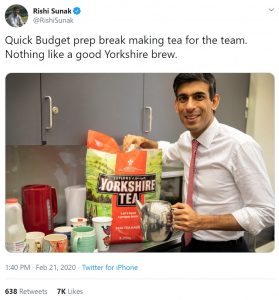
As comedy writers, we value laughter above nearly everything else. So yeah, we’ll admit it. Every now and again, we make a joke that takes aim at somebody specific — but we always think carefully about how it might make them feel and, fundamentally, we try to be kind. Unfortunately, not everyone shares this ideal, and this is abundantly clear when it comes to social media. We interrupt our usual programming of Funny Ads analysis to bring you this case study of Yorkshire Tea, who, in their own words, had a ‘rough weekend’ on Twitter. Read on to find out how they not only weathered the storm, but came out the other side smiling. Hint: it’s all thanks to their funny social media marketing team! How Yorkshire Tea used Comedy on social as Damage Control The Problem When the newly appointed Chancellor of the Exchequer, Rishi Sunak, posted this picture on Twitter, the sound of a marketing team’s sphincters tightening echoed across the Yorkshire dales: Presumably, the Tory thought this would be a great way to show the people of the North of England that he’s one of them. Unsurprisingly, Twitter wasn’t buying it. The majority of the backlash however, wasn’t aimed at Mr. Sunak — it was aimed at Yorkshire Tea. Some commenters called for a boycott on the indisputably scientific grounds that, ‘if a person I dislike enjoys this tea, I can’t possibly enjoy it’, while others flat out accused the brand of striking an endorsement deal with the Tory government. Step aside, Kardashians! It turns out that politicians are the most desirable influencers on social media. Yorkshire Tea’s social media marketing team was quick to respond, by tweeting: “Nothing to do with us – people of all political stripes like our brew. Plus there’s no way we’d intentionally stick ourselves in a Twitter storm on a Friday afternoon. It’s nearly hometime!” This tweet conveyed the important information, but humanised it with a light-touch joke in the brand’s tone of voice — a fine example of funny social media customer service.  However, this did little to slow the onslaught, and the negative brand mentions continued to stack up over the weekend… The Solution On Monday morning, presumably immediately following a panic meeting and many a strong cuppa, @YorkshireTea tweeted a thread summarising their ‘rough weekend’. They included screenshots of all the action and, in an echo of the recent #BeKind hashtag that’s been trending in the wake of Caroline Flack’s tragic death, urged social media users to ‘try to be kind’. This response reads as sincere. Aside from their initial tweet on Friday afternoon, they haven’t tried to be funny. We know they’re more than capable of funny (more on this later), but the team behind the tweets identified that sincerity and openness would play better here.  They were right.  Now, numbers aren’t everything. We’re in no way insinuating that Yorkshire Tea’s response was overly calculated or anything less than genuine, and we wholeheartedly endorse the positive message they’ve chosen to use their moment in the spotlight to promote. BUT, when you’re trying to convey a brand message to the widest possible audience (whether it’s about the launch of a new product, or more of a damage control situation like this) numbers matter. We live in a Black Mirror episode, after all. At the time of writing, the first tweet in the thread is sitting happily around the 38K likes mark, and the last (with its wholesome parting message) at a whopping 46K! By contrast, the photo that triggered the whole palaver has less than a quarter of the likes, and is lagging by over a thousand comments. BOOM. *Insert middle finger up emoji aimed at Rishi Sunak and everyone who had a pop at Yorkshire Tea…just don’t forget to delete this text afterwards.* True, the overall impact on the brand will be hard to measure — especially so soon after what we’re sure will henceforth be known at Yorkshire Tea HQ as ‘the incident’. But the social media team did all they could, and the available numbers suggest they took the best possible approach. Of course, we’d expect nothing less from the Yorkshire Tea social media marketing team, whose work we’ve been admiring for a while now.  Masters of the Craft In our own bid to be kind, we decided to showcase some of the Yorkshire Tea team’s funniest recent work. In fact, we reckon they’re one of the funniest brands on social media. Comedy comrades on the Yorkshire Tea social media marketing team — we salute you! 1.So many brands posted half-arsed attempts at the #DollyPartonChallenge. While not one of their highest performing tweets, YT showed their comedy chops and went the extra mile. Get you a tea that can do it all. #dollypartonchallenge pic.twitter.com/BiPTDWjz3T — Yorkshire Tea (@YorkshireTea) January 24, 2020 2. Oh, the innocence. Just a few weeks prior to ‘Tory-gate’, this gentle little joke scored great engagement — which just goes to show how cultivating your brand’s playful tone of voice and tailoring content to the sensibilities of your specific audience can deliver results. It's horrid out there! Best just stay indoors and drink tea all day. [This opportunistic tweet was brought to you by the Yorkshire Tea marketing department] — Yorkshire Tea (@YorkshireTea) February 9, 2020 3. We loved this animated video and accompanying hashtag campaign that YT put out for ‘National Tea Day’ last year. Apparently, a teapot emoji will be launched in March 2020, so we can only assume that YT will be producing a celebratory follow-up video (if you’re reading this, YT, we’d love to help you script it). We, the people, demand a true tea emoji! No longer will we sit idly by, sending tiny pictures of green 🍵 or very dark brown ☕️ hot drinks. We are a nation of tea drinkers. It is #NationalTeaDay. It's time to make a stand. Let's have a proper #teamoji. pic.twitter.com/wM7PsfzgWi — Yorkshire Tea (@YorkshireTea) April 21, 2019   For more

Read More »

Want us to help your brand find its funny?

Let's Talk

Want to learn how to do it yourself?

Sign up for our FREE training course