Category: Our Verdict On

Honeypot shows that engaging content that travels > Paid Ads that doesn’t

As a marketer (and as a former single man) I’ve seen countless Dating Apps burst onto the scene with a huge fanfare telling us all that they’re the next big thing. Some of them (like Bumble and Hinge) stick around and challenge the status quo. Others (like Carrot. Anyone remember Carrot? No – me neither – but Google says it was a thing) disappear into the night having failed to find love for their users, or for themselves. Here’s how Honeypot used Guerrilla Marketing to make their content travel for free Launching a new Dating App must be a logistical nightmare. If you’re launching a productivity tool, and on Day Two you only have one user – that user might still love it, keep using it, and eventually spread the word. A Dating App with just one user, though? They’d last all of 7 seconds before deleting you, and heading back to Tinder. To succeed in the dating space, you need to get a critical mass of single people onto your app at the exact same moment – and each one needs a whole load of the others to either live, or work, nearby. The most obvious way to do it is to throw Advertising Money at the problem. Sure, it’ll cost you hundreds of thousands right now – but in the long-run it’ll pay off. (Or at least at will if your Dating App is among the 10% that succeed, and not one of the 90% that flop). But there is another way. I first heard about Honeypot back in August, when a friend tweeted a picture of their first ever stunt – a whiteboard outside the tube, supposedly put there by a girl angry at her cheating ex boyfriend. It was funny. And believable. And it ended with a final p.s. – “You’re deluded if you think Honeypot is the next Hinge”. The picture went viral. In fact – lots of pictures of the same board all went viral. And all of them contained that tiny bit of stealth marketing: the idea that Honeypot maybe IS the new Hinge. That stunt was the first of many – and Honeypot’s founder and CEO George Rawlings has since pledged not to spend a single penny on Paid Advertising. At least, not any time soon. I reached out to ask him if he had any stats tell us how well this Guerrilla Marketing is doing – and while for obvious reasons he didn’t want to give away anything commercially sensitive, he did tell me that their most recent campaign (another whiteboard, this one pretending to be from three of his own employees, all using instagram to “quit” because they’ve found out he – their “pig of a boss” – had been sleeping with all three) cost them a total of £39.99 to run, and brought in engagement equivalent to £4,200 worth of Paid Ads. That’s an exceptional ROI. And it’s not just the stunts. Their social feeds are full of relatable jokes that celebrate the ups (and downs) of single life – which helps reinforce the message that the people behind the App really are “just like me”. There’s one thing I want you all to learn from Honeypot – and this applies whatever kind of product, service or brand you’re trying to market: You should start spending your money on engaging content that travels, and stop spending it on Paid Ads that don’t. I’m not saying you won’t need Paid Ads – you just don’t need Paid Ads that suck. If your current Ad is bringing in 500 new users a day, but you need 1,000 – don’t fall into the trap of thinking the only way to do that is double your spend. Instead – craft some content that’s actually compelling. Actually engaging. Something your audience would want to consume even if you weren’t paying to place it in front of their eyeballs. Put out five pieces, see which ones travel the furthest – and then use your Ad Spend to place those pieces in front of our eyeballs. You’ll get the results you need, without having to spend twice as much. There is one thing I think Honeypot could do better though… I’m absolutely loving their approach – and over the last few months I’ve seen it really work for them – but I do think they’re missing a trick. Honeypot genuinely sounds like a really innovative App – with a whole load of USPs that make them stand out from the crowd. The fact that it doesn’t just “feature” instagram-style stories – it’s powered by them – giving matches a taste of you right now, rather than you in those 5 carefully curated holiday pics. The focus on spontaneous dates for those who want less chat and more meet-ups. The idea of the “Honeypot” as a local area that’s full of single people, and great for meeting your match. They’ve done a great job of hiding a marketing message inside the viral content generated by their stunts – but that marketing message simply says “we exist”. They want to position themselves as the next Hinge – and they’re doing that well – but they’re more than just the next Hinge. They’re unique – and I’d love it if their stealth marketing, once unpacked, could also communicate that uniqueness. It’s easier to do than you’d think. Especially with a hive-mind of Comedy Creatives sitting in your back pocket. Speaking of Stealth Marketing – here’s a bit of ours… Thinking about using Comedy Content to boost your brand online – but not sure where to start? In our new E-Book, we’ll walk you through five foolproof ways to turn your brand message into comedy content – and show you exactly how some of the world’s biggest brands have put those methods into practice, in ways you can easily replicate. Find out which simple technique SpecSavers Opticians have been relying on to keep themselves in focus for the last two

Read More »

The BBC’s #XmasLife Campaign – an Ad full of Missed Opportunities

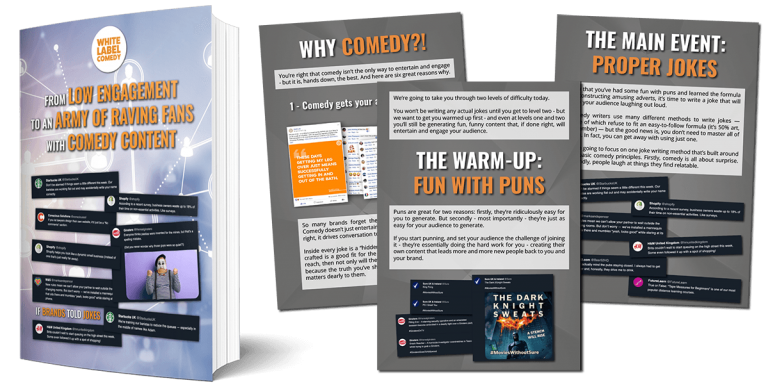
Yesterday, the BBC unleashed its Christmas Campaign. Just after Strictly Come Dancing on BBC One – the “#XmasLife” advert got it’s debut. You can watch it here: https://www.youtube.com/watch?v=ACjdP_Pxf40 Now there’s a lot about this advert I like. I like that they’re positioning Christmas as a way to “wash away” all the tensions of what we’ll all agree has been a pretty depressing year. I like the use of Graham’s “Red Chair” lever as a device that sends us forwards in time to Christmas. And I love the visuals, the wholesome family feel, and the fact that they’ve tried – as best they can – to make it fun, and funny. The problem, though, is that the piece is full of missed opportunities. From the guy who bursts into the office dressed as a tree, to Rochelle Humes in bed telling us “It doesn’t matter what time I wake up” – I must’ve counted 10 moments that felt like the set-up to a joke, but that never get resolved with any kind of punchline. It reads to me like a script that used to be loads funnier – but that got hacked apart because someone somewhere had a panic that it wasn’t going to be wholesome enough. I could be right, I could be wrong. And you know what – I fully respect the decisions BBC Creative have taken with it. When you’re being funny on behalf of a brand – especially a brand with as much heritage as the BBC – the worst thing you can do is make the wrong kind of joke. You risk alienating your audience and turning them against you. One way to avoid making the wrong kind of joke is to not make any jokes at all. Another way – the better way – is to make the right kind of jokes to begin with. I’ve been thinking a lot lately about the brands that are the most successful using Comedy Content to engage their audience – and they have a few things in common. Firstly – they always start with their brand message – and they make sure each and every joke supports it. And secondly – in order to get them there in the first place – they often seem to use the same simple, repeatable methods to “find” those jokes. And they use them over and over again. Presumably because these methods are great for generating fun, funny ideas that aren’t going to backfire. My point is this: Maybe there were a whole load of jokes in there that got cut because somewhat got cold feet. Maybe there were never any jokes – because they wanted a wholesome, family-friendly advert and they decided humour was too risky from the get-go. But humour’s only risky in the wrong hands. There are millions of theories floating around about what a joke “is” – but if you’ll indulge me by letting me pitch my favourite, and then I’ll explain why. As far as I’m concerned – the only true definition of a joke is this: it’s two distinctly separate ideas coming together with the help of a twist that magically ties them together. And when you analyse it along those lines – there are loads of risk-free ways to take the content already right there in the advert (2019 + Christmas + Family + The BBC) and tie the elements together in a manner that sparks that joy and gets that laugh. I’m not saying that every advert has to be funny (although obviously I’d love it if that were the case – more work for us!) – but for a piece that’s so full of what seem like set-ups, why not go the whole hog and actually make a joke. For what it’s worth, my treatment for the #XmasLife campaign would’ve had the negatives of 2019 threaded throughout – with the joys of Christmas (and Christmas Telly) used to combat each and every one. And yes – it would’ve been full to bursting with jokes. They didn’t hire us this year – but we’ll keep an eye on our inbox in case they need us in 2020.   Free E-Book – 5 Foolproof Ways to Make Your Brand Funny Thinking about using Comedy Content to boost your brand online – but not sure where to start? In our new E-Book, we’ll walk you through five foolproof ways to turn your brand message into comedy content – and show you exactly how some of the world’s biggest brands have put those methods into practice, in ways you can easily replicate. Find out which simple technique SpecSavers Opticians have been relying on to keep themselves in focus for the last two decades. Discover how Amazon recently managed to get us laughing not just with, but at them, without even the tiniest risk to their reputation. And learn how brands like Lego have been supercharging their engagement on social by jumping on-board breaking news stories fast – with their own funny twist. For your free copy, just head to whitelabelcomedy.com/free

Read More »

Want us to help your brand find its funny?

Let's Talk

Want to learn how to do it yourself?

Sign up for our FREE training course